

Leaving
A social innovation app that efficiently connects customers with independent movers, localized for Latin America.
Leading an AI-powered UX team through research, design, and development of MVP. I helped define the design system, review project goals with stakeholders, and pivot to an agile workflow.
My Role
Lead UX Designer &
Product Management
Team of 4
Scope
Web App
Mobile App
Admin Dashboard
Design System
Tools
Figma, Figjam
Claude.ai, Notion, Jira
Problem Statement
Independent drivers struggle to build a sustainable moving business because they lack the visibility to attract consistent customers, the tools to establish trust and credibility, and the market knowledge to price their services competitively, leaving skilled, reliable drivers trapped in cycles of inconsistent income and undervalued work.
Goals
Short-term
Activate local economies in Latin America by connecting customers to verified, transport providers struggling to find consistent work.
Long-term
-
Fund social programs to train independent drivers who wish to evolve into micro-enterprises.
-
Reduce travel CO2 emissions through built-in efficient operations systems that connect to SDG 13 climate action initiative.
Challenges
I joined the project when prototyping was in production.
The team was working without a clear plan or strategy.
Gaps and Challenges
-
No prior market or user research
-
Problem space and market strategy were undefined
-
Building an MVP without a targeted market
-
Fragmented processes following the waterfall approach
My Contribution
Redirect the team toward an agile, design thinking framework, shifting the focus from sequential task completion to iterative, research-driven problem-solving.
The Pivot
Before
I was looking for some clarity and basic assumptions to base design decisions off of.
I had many questions, for example:
-
What are the business goals?
-
Why makes it a social innovation app?
-
Are there KPIs established?
-
What insights came out of the research?
-
Have you defined personas?
-
What market are we designing for?
After
Lacking clear answers, I introduced transparency and structure to the team.
New Processes
-
2-week design sprints
-
alignment with the board of directors to clarify goals
-
clear design documentation and shared access to the entire cross-functional team
-
collaborative market research organized in Figjam
Research
While we drafted wireframes of the general user flows, the team conducted much needed research to validate assumptions.
Step 1: Market Research
In order to quickly get a picture of the Latin American market and potential users, we conducted market research to form assumptions that could more clearly drive design decisions.
Competitors
We identified 5 global, well-established indirect competitors (Dolly, Lugg, GoShare, Taskrabbit, and Shiply) and 2 direct competitors in Latin America, Mudango and Mudanzas M&H.


Insights
Research revealed that Brazil and Mexico have the largest market share for residential moves and the adoption from cash to digital transactions is one common challenge in Latin America. Competition is high and valuable to research apps that do well in these countries.
Market Opportunity
Panama was identified as a potential market to test out an MVP since it is not saturated, smaller scale but high local demand. The community currently uses Whatsapp and cash transactions.
Step 2: Competitive Analysis
Research revealed two clear customer experience strategies.
1. A fast, light booking experience with minimal onboarding
2. Detailed, guided planning and operational clarity
Insights
Successful platforms have built user trust through transparency and user satisfaction ratings. To identify pain points and opportunities, we mapped out the current CX journey for customers.
What works well:
-
Clear pricing to build customer trust
-
A simple pricing structure vs detailed breakdowns
-
Clear terms of service for both operators and customers
MVP
We decided it is critical to gauge user adoption in Panama. The MVP would be a lightweight customer + driver app to build digital habits to drive the local economy.

Pain Points
Research revealed...
Customers
-
Hard to find trusted, vetted movers
-
Pricing is negotiated and inconsistent
-
No way to track or coordinate the move
Drivers
-
No platform to find consistent work
-
No way to build a verified reputation
-
No credit-building since payments are in cash

Design
To address the pain points, critical points were mapped out in the user flows.
For Customers
-
Clear, step-by-step onboarding
-
Transparent move pricing and estimates
-
Deposit-to-final payment flow
-
Clear contract and T&C screen
-
Move tracking with ratings and reviews
For Drivers
-
Quick, intuitive verification onboarding
-
Transparent pricing and profit margins
-
Secure payment holds
-
Clear contract and T&C screen
-
Flexible, customizable scheduling

*Low-resolution previews provided for process reference. Detailed content restricted for privacy.
UI and Visual Design
A new design system was created and logo design

Original Customer Flow
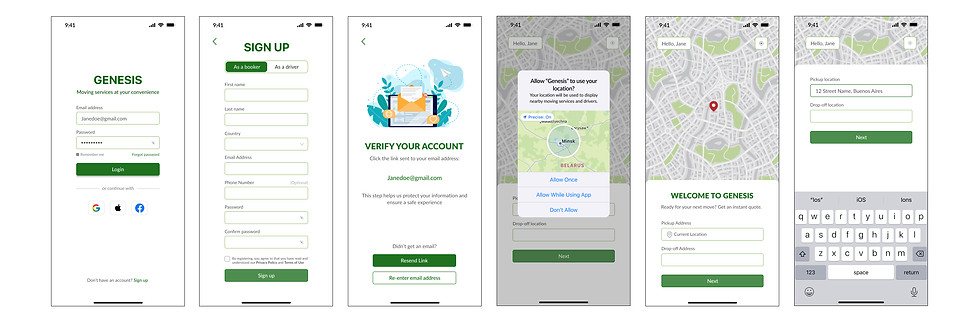
Pain Points
Trust & transparency,
-
No introduction to the service or expectations
-
Might feel like a bait-and-switch
Friction & Drop-off
-
Users forced to sign up before discovering if they like the service
-
Users question, is it worth their time and effort to sign up?
Onboarding Flow Studies
We explored short, informative onboarding flow options, appropriate for a new app in a market that is not used to using digital platforms for moving services
Minimal Onboarding (1 screen overview with quick sign up)
-
1 intro screen on big-picture
-
Quick sign up with phone number
Value Onboarding (informative intro before sign up)
-
step-by-step process and value proposition that lead to sign up
Quick-Start Onboarding (see value before sign up)
-
Users experience the app's service first
-
Sign up happens after move estimate

Web Landing Page + Mobile Prototype
The MVP will be revised with a focus on the market in Panama.


Low-resolution previews provided for process reference. Detailed content restricted for privacy.
Lessons Learned
-
Align on goals before designing full-speed
-
Research first, then design, build and iterate
-
Documentation keeps teams aligned and engaged
-
Structured processes unlock faster decisions
-
Surface ambiguity early to focus the goals